

What is DDH?
DDH is a spectrum of abnormal hip development from mild underdevelopment of the hip through to hip dislocation. This is usually present from birth (congenital) but can also develop during infancy or childhood. It consists of two components:
- The depth of the socket (acetabulum)
- The position of the ball part of the thigh bone (femoral head) within the socket.
What causes DDH?
DDH can be a result of many different factors including family history, the position of the baby in the womb (for example breech) and first-born child.
How will I know if my baby has DDH?
When your baby is born, the doctor or midwife will routinely check your babyÎÚÑ»´«Ã½ hips and if they feel any instability, your baby will be referred for a hip ultrasound. The hips will be assessed again by your GP when your baby is around six weeks old. If your baby has a risk factor for DDH, they will be referred for a hip ultrasound even if they have stable hips on examination. Risk factors are: family history of hip dysplasia, breech presentation after 36 weeks, breech birth, oligohydramnios (low fluid levels in the womb), or multiple birth.
What happens if my baby is diagnosed with DDH on ultrasound?
You will receive a referral to our hip dysplasia clinic where we will assess your babyÎÚÑ»´«Ã½ hips and review the ultrasound scan. If it is felt that the hips need to be treated, it is likely that the team will discuss using a Pavlik harness with you. This will help the babyÎÚÑ»´«Ã½ hips to develop in the most normal way.
What is a Pavlik harness?
A Pavlik harness is a soft fabric harness which allows the baby to move his or her legs around but will stop them moving the hip in and out of the socket. It has a chest strap, two shoulder straps and four leg straps that attach to little ‘booties’. This will be applied directly to the skin.

How does the Pavlik harness work?
The goal of the harness is to keep the ball of the hip joint pointed towards the socket while the baby moves his or her legs. The baby will be encouraged to rest into a position where the hips are bent (flexed) and held out to the side (abduction).
Will I have to care for my baby in a different way?
When the harness is first put on, the length of the straps will only be altered by a member of the orthopaedic team, who will mark the straps with a pen. Parents can loosen/tighten the chest strap for feeding.
Loose clothing needs to be worn around the harness and we suggest you hold your baby with their legs apart (as they are in the harness) to prevent the legs from coming together. Babies will wear their harness for 24 hours a day. The harness is then removed in clinic and the baby can be then be bathed and weighed.
The harness is on for 24 hours continuously, removing the harness (for example for bathing) is not allowed. Therefore parents will need to give regular top to toe washes around the harness. If fluids such as poo get onto the harness you will need to clean it off the best you can with baby wipes. If your baby grows or the harness is very dirty, it will be replaced in clinic.
How long will my baby have to wear the harness?
It is likely they will have to wear the harness full time for six to twelve weeks. Most children will be treated with a harness for between six to twelve weeks.
Hygiene care
You will be able to bathe your baby weekly in the clinic. Please bring a towel, soap, flannel and new clothes. A damp flannel/ wet wipes can be used to clean your babies skin in between the weekly baths. Pay special attention to the numerous skin folds in neck, arm pit and groin areas. It is common for the skin in the groin to become irritated. Nappy rash cream is useful in this situation. Your babies skin will be reviewed weekly in clinic.
Please observe your babies skin for rubbing and skin marking from the straps. If this occurs please inform the team.
Nappy changes can be fiddly at the beginning. The nappy needs to go under the straps of the harness.
Equipment
Car seats- They will usually fit into their current car seat. The harness will keep their legs apart. Do not force their legs together.
Pram- They will usually fit into their current pram.
Baby Bouncer- are not allowed to be used during the Pavlik harness treatment.
Baby Walker- are not allowed to be used during the Pavlik harness treatment.
Baby Carrier- This needs to support the babies’ thighs and not allow the legs to dangle. Please bring your carrier to clinic so it can be reviewed.
Play
Tummy time in the harness is allowed but do not leave your baby unattended during this time. The important thing to consider when a baby is on their tummy in a harness is making sure the hips remain spread apart. With younger babies, tummy time can be undertaken on a parentÎÚÑ»´«Ã½ chest, with the parent in a reclined position. If they are doing tummy time on the floor, a rolled-up towel under the chest is useful. Once the baby has good head control the towel will not be required. Tummy time may not be tolerated for long periods. If they look uncomfortable, please change their position.
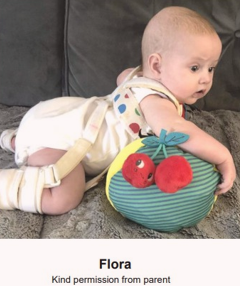
Feeding
You may need to adjust feeding position whilst your baby is in the harness. Breast feeding will still be possible in the harness. A v shaped maternity pillow maybe useful.
Clothing
Whilst wearing the harness your baby may need to wear adapted clothing. Hip dysplasia clinic can be purchased online from George,John Lewis,,, Next, Marks and Spencers. Second-hand clothes can be purchased from Vinted and Ebay. A bigger size clothing may fit over the harness. Vest extenders can be purchased instead of buying larger vests.
Sleeping
Your baby may be unsettled for the first night after the harness fitting but they usually adjust quickly to this. The same may happen when the harness is removed.
How will I know if the harness is working?
You will have weekly appointments with the team where the harness will be checked to ensure that it is fitting correctly and is providing the correct support. Regular hip ultrasounds will be undertaken so that we can check how the hips are developing.
What happens if the hips do not correct with the harness?
The team will discuss your babyÎÚÑ»´«Ã½ progress at each appointment. If they feel that the hips are not developing in the normal way even with the Pavlik harness, they will discuss the future treatment options and the harness treatment will be stopped. Each baby is different.
Can the harness harm my baby?
Pavlik harness treatment is the safest of the various treatments for DDH. However, in rare cases, there is a chance of temporary femoral nerve injury when the leg does not kick actively. This can be corrected by changing the position of the babyÎÚÑ»´«Ã½ legs in the harness and the orthopaedic team will be assessing for this. If the chest strap presses in the armpit, this can cause temporary damage to the nerves to the arms. It is important that there is a gap of two finger breadths under the chest strap and moving arms freely..
It is important to observe your baby regularly and make contact with the team if your baby stops kicking / moving their legs / feet. If it is a weekend please remove the harness and make contact with the team in working hours.
There have been occasional historical cases of avascular necrosis (loss of blood supply to the ball of the hip joint) and damage to the socket. We think this is because the harness was previously used for older babies and for longer than we use them for now.
There is no clinical evidence that wearing a pavlik harness delays motor development.
It is important to contact the hospital if:
- The babyÎÚÑ»´«Ã½ feet are constantly slipping out of the booties
- You feel the baby has grown and the harness is too tight
- If the baby has persistent red marks around any of the straps.
- If your baby is not kicking their feet/ legs (as if kicking a football from the knee) or not moving their arms normally.
What happens when treatment is successful and the harness is removed?
We will review your baby in clinic at 6 months of age. An X-ray will be undertaken to assess their hips.
We will follow up their progress at 1 year, 18 months of age and 3 years of age and then hopefully discharge.
Useful contact numbers:
- The Paeds orthopaedic secretary: Tel: 01223 216101 email e-mail the paediatric orthopaedic secretary
- Clinical Nurse Specialists
Email
Tel: 01223 254996.
National Support Group:
- The National Association for Children with Lower Limb Abnormalities,
They also have a Facebook page. 01925 750271.
Useful websites:
- .
- My Hippy Baby UK and Ireland (Hip Dysplasia) - Facebook Group
Books:
- Cast life: A parent guide to DDH, Developmental dysplasia of the hip explained by Natalie Trice.
- The Parents’ guide to hip dysplasia by Betsy Miller.
- Hope: The ‘Hip’ hippo by Gina Jay and Julie Beattie.
We are smoke-free
Smoking is not allowed anywhere on the hospital campus. For advice and support in quitting, contact your GP or the free ÎÚÑ»´«Ã½ stop smoking helpline on 0800 169 0 169.
Other formats
Help accessing this information in other formats is available. To find out more about the services we provide, please visit our patient information help page (see link below) or telephone 01223 256998. www.cuh.nhs.uk/contact-us/accessible-information/
Contact us
ÎÚÑ»´«Ã½
ÎÚÑ»´«Ã½ Foundation Trust
Hills Road, Cambridge
CB2 0QQ
Telephone +44 (0)1223 245151
/contact-us/contact-enquiries/